The "I Can Still Do It" Trap: When Independence Hides Declining Fitness
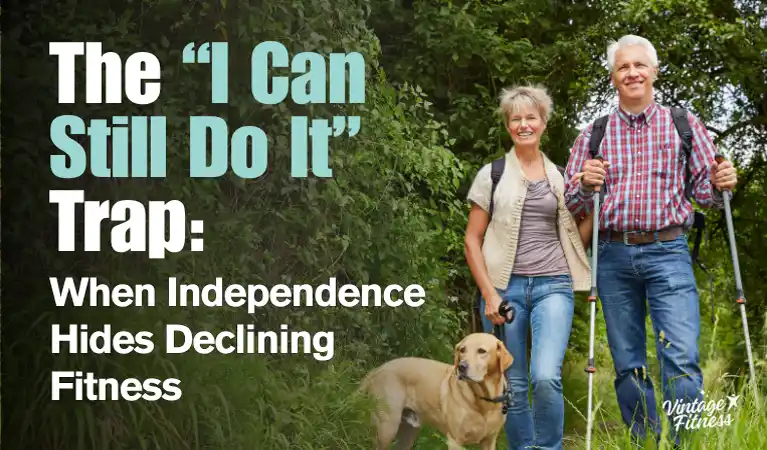
"I can still do it."
It's something we hear all the time, and it sounds like a good thing. It is a good thing. But there's a quieter question worth sitting with: how exactly are you doing it?
It's Not About Whether You Can, It's About How
You might still climb the stairs, but maybe now you pull yourself up on the railing. You can still get out of your favourite chair, but you push off with both hands to do it. You still carry the groceries in, but it takes three trips instead of one. You can still go for a walk, but you've started avoiding hills, uneven sidewalks, and the longer routes you used to enjoy.
Technically, you're still doing everything yourself. That matters, and it's worth being proud of. But your body may be working a lot harder behind the scenes to get it done.
Independence Isn't an On or Off Switch
We tend to think of independence as something you either have or you don't. In real life, it comes in degrees, and those degrees shift slowly.
Physical changes rarely announce themselves. You compensate a little here, find an easier way around something there. You quietly stop doing the activities that have started to feel like too much. One day you look up and realize your world has become a bit smaller than it used to be, and you're not quite sure when that happened. It tends to sneak up on you.
None of this means anything is wrong with you. It's simply how the body ages when movement drops off. The encouraging part is that the same process works in reverse. Strength, balance, and mobility respond to training at 60, at 75, and well into your 80s and beyond.
What Functional Fitness Actually Protects
"Functional fitness" is just a plain way of describing the kind of fitness that everyday life actually asks of you. It isn't about lifting heavy or running fast. It's about the specific abilities that keep your day yours:
- Strength to rise from a chair, the toilet, or the car without using your arms.
- Balance to turn quickly, step over a curb, or catch yourself on a slippery winter sidewalk.
- Mobility to reach the top shelf, do up a back zipper, or get in and out of the bathtub.
- Coordination and reaction to recover a stumble before it becomes a fall.
When those abilities stay sharp, the small moments of the day stop being something you have to think about. That's really what we're protecting here. Not a number on a chart, but the freedom to move through your own life without negotiating with your body first. If you want a quick sense of where you stand, our functional fitness and independence quiz for seniors is a good place to start.
One of our clients, Pearl, put it better than we could:
"Your bright smile and steady encouragement has brought me from not being able to stand up from a sitting position on a very low sofa; to standing up consecutively. Ana has me climbing stairs up and down. I feel confident with her beside me it will get easier as we move forward."
Independent Today, Capable Tomorrow
Here's the way we'd invite you to look at it. Being independent today is wonderful. Staying capable tomorrow is the goal.
So if you're cruising along right now, comfortably doing your own thing, that's great news. Just don't coast on it. The people who hold onto their independence the longest are usually the ones who kept training a little before they felt they needed to, not the ones who waited until something got hard.
Dee, who started with us already active, found that out firsthand:
"My respiratory system, flexibility & muscle strength has improved immensely which in turn improves my confidence. I know now if I were to have a tumble (fall) I have the strength & maneuverability to get myself upright independently."
That's the quiet confidence functional fitness buys you. Not the promise that nothing will ever go wrong, but the knowledge that your body can handle it when it does. If a fall or a scare is already on your mind, our post on regaining confidence and fitness after a fall walks through where to begin.
Frequently Asked Questions
- What's the difference between being independent and being functionally fit?
- Independence is whether you can complete a task. Functional fitness is how easily and safely you can complete it. You can be technically independent while quietly compensating with railings, armrests, and extra trips. Functional fitness closes that gap so daily tasks feel genuinely manageable, not just barely possible.
- How do I know if I'm compensating without realizing it?
- A few honest signals: you push off with your hands to stand, you avoid stairs or hills when you can, you plan routes around places to rest, or everyday chores leave you more winded than they used to. None of these mean something is wrong. They're simply signs it's worth checking in on your strength and balance before they slip further.
- Is it too late to rebuild strength in my 70s or 80s?
- No. Research is clear that older adults build strength, balance, and mobility at any age, and we see it in our clients every week. Progress may look a little different than it did at 40, but the body keeps responding to training throughout life. The best time to start is simply now.
Keep Your World as Big as Possible
A personal trainer who specializes in seniors can spot the areas that are slipping before you'd notice them yourself, and build a program around the movements that matter most to your daily life. That's our whole focus.
We start with a comprehensive assessment designed for seniors, done right in your own home, so we can see how you actually move through your space. From there we build a plan, hold you accountable, and reassess as we go, so you're not just holding steady, but genuinely progressing. Our goal is your goal: to keep your world as big as possible, for as long as possible.
And if there's a question you'd like us to tackle in an upcoming post, or a topic from a past article you'd like us to go deeper on, we'd love to hear it. Our best posts usually start as a reader's question.
Call us at 1-866-471-0109 to get started.
RSS Subscribe:

Search
Categories
- Abdominal / Waist Exercises
- Aches and Pains
- Aging Well
- Arm Exercises
- Arthritis
- Back exercises
- Balance for Seniors
- Core
- Diabetes
- Elastic Band Exercises
- Exercise Programs
- Fitness Goals
- Flexibility Exercises
- Guest blog
- Hands
- Heart Health
- Incontinence Exercises
- Knees
- Leg Exercises
- Mental Health
- Neck Exercises
- Nutrition
- Osteoporosis
- Other
- Personal Training
- Posture
- Sciatica
- Shoulder
- Strength Exercises
- Stretching Exercises
- Success Stories
- Virtual Training
- Webinar
- Weight Loss
- Women’s Health