Why Your Brain Loves New Exercises
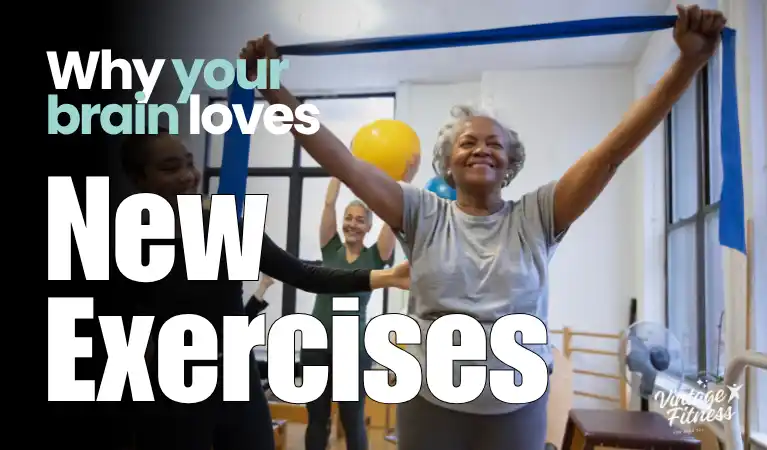
You've probably heard people say the brain is like a muscle: if you don't use it, you lose it. What you may not realize is that using your brain isn't limited to things like chess, crosswords or sudoku. Your brain is also stimulated by simple variety in what you do. Your brain likes a challenge, and that includes your workouts.
Why Variety Matters for Exercise and Brain Health in Seniors
Doing the same exercises over and over can be great for building consistency (yes, we're always going on about consistency). But your brain and body also benefit from variety. Learning a new movement, changing your balance position, adding coordination, or trying a different strength exercise gives your brain something new to figure out.
What the Research Says About Variety and the Brain
Researchers compared adults who did a wide range of different activities in their daily lives with adults who kept to a narrower routine, and then checked in with them again years later. Their study, published in the Journal of Gerontology and available through the National Institutes of Health's PubMed library, concluded that:
"Greater activity diversity was associated with higher overall cognitive functioning and higher executive functioning. Overall cognitive functioning, executive functioning, and episodic memory were better in those who had higher activity diversity, or increased activity diversity, compared to those who had lower activity diversity or decreased activity diversity over time."
The study looked at everyday activities in general, not only exercise. Still, the message lines up with what we see in our clients every week: a routine that keeps changing gives your mind more to work with than one that stays exactly the same.
Why Solo Routines Tend to Stay the Same
When you exercise on your own, it's easy to fall into the same comfortable routine: the same walk, the same exercises, the same number of repetitions. Comfortable isn't bad. It just means that after a while, your brain doesn't have to pay much attention anymore.
How a Personal Trainer Keeps Your Workouts New
That's one reason working with a personal trainer for seniors can be so valuable. Your trainer creates a program for you from the ground up, and it's progressive, meaning each session builds on the one before it, changing and evolving along with your body. A trainer can keep introducing safe, purposeful challenges that work your strength, balance, mobility, coordination and reaction time in different ways.
Our clients notice the difference. Julie, who trains with Ana Rojas, described it this way:
"she is attentive and positive, varying the exercises so that workouts are always fresh and new."
Simple Ways to Give Your Brain Something New
And this doesn't mean complicated workouts. Sometimes simply changing how you move is enough to make your brain and your body pay attention. Here are a few examples of the kinds of changes a trainer might build into your sessions:
- Change your base: Move from feet hip-width apart, to feet together, to one foot slightly in front of the other, with a counter or sturdy chair within reach.
- Add coordination: March in place while tapping your opposite hand to your opposite knee.
- Move in new directions: Step sideways or backward, not only forward, the way you do in real life around the kitchen or in a crowded store.
- Think while you move: Count backward by threes or name a fruit for each letter of the alphabet while you step or walk.
- Switch the equipment: Trade dumbbells for a resistance band, or add a gentle ball toss and catch to work on reaction time.
Why Safety Matters So Much
That's where having an experienced seniors fitness specialist makes a difference. A trainer takes the guesswork out of what to do next and helps you keep challenging yourself safely. Safety is particularly important for older adults. The right challenge is hard enough to make you think, but never so hard that it puts you at risk of a fall. If balance has been a worry for you, our post on regaining confidence and fitness after a fall is a good place to start.
Families often notice the changes too. Russell Drago shared this about his father's in-home sessions:
"At age 91, my father has noticeably improved his strength, endurance, cognition and confidence through in-home training sessions with Neville, twice a week over the past year."
Every person is different, and results like these reflect one family's experience. What they show is what steady, varied, well-guided exercise can look like over time.
Your brain loves new things. Give it something new to move with!
Frequently Asked Questions
- What type of exercise is best for the brain?
- There isn't one single best exercise. A mix tends to work best: activity that gets your heart working, like brisk walking, plus strength training and balance and coordination work. Canada's physical activity guidelines for adults 65 and older recommend about 150 minutes of moderate to vigorous activity each week, muscle-strengthening activities at least twice a week, and activities that challenge your balance. Adding variety within that mix gives your brain new things to learn.
- Are brain games like puzzles and sudoku enough on their own?
- They're good for you and worth keeping. Physical exercise adds things puzzles can't, like stronger muscles, better balance and a healthier heart. Movement that also makes you think, such as learning a new sequence or a coordination drill, gives you both at once.
- How often should I change my exercise routine?
- You don't need to start over. Keep the core exercises that work for you and change one small thing every few sessions: a new variation, a different balance position or a new direction of movement. A trainer does this for you, progressing your program session by session so it stays challenging without being overwhelming.
- Is it safe to try new exercises if my balance isn't great?
- Yes, with the right setup. Try new balance moves beside a counter or sturdy chair, go slowly, and have someone nearby when you can. If you have a condition that affects your balance or you've had a recent fall, check with your doctor first. A trainer who specializes in older adults can match each new exercise to your current ability.
- Can exercise prevent dementia?
- No exercise can guarantee that. Research does link regular physical activity with better cognitive health as we age, and it works best alongside good sleep, social connection and managing conditions like high blood pressure. Our post on leg strength, falls and dementia looks at this more closely. If you're concerned about your memory, speak with your doctor.
Ready for Workouts That Keep You Thinking?
Vintage Fitness builds customized, progressive in-home and virtual fitness programs for older adults across Toronto and the Greater Toronto Area. Your trainer will keep your sessions fresh, safe and matched to your goals. Call us at 1-866-471-0109 or book online.
RSS Subscribe:

Search
Categories
- Abdominal / Waist Exercises
- Aches and Pains
- Aging Well
- Arm Exercises
- Arthritis
- Back exercises
- Balance for Seniors
- Core
- Diabetes
- Elastic Band Exercises
- Exercise Programs
- Fitness Goals
- Flexibility Exercises
- Guest blog
- Hands
- Heart Health
- Incontinence Exercises
- Knees
- Leg Exercises
- Mental Health
- Neck Exercises
- Nutrition
- Osteoporosis
- Other
- Personal Training
- Posture
- Sciatica
- Shoulder
- Strength Exercises
- Stretching Exercises
- Success Stories
- Virtual Training
- Webinar
- Weight Loss
- Women’s Health