Push-Ups at Every Age: The 3 Generations Challenge, Part 2
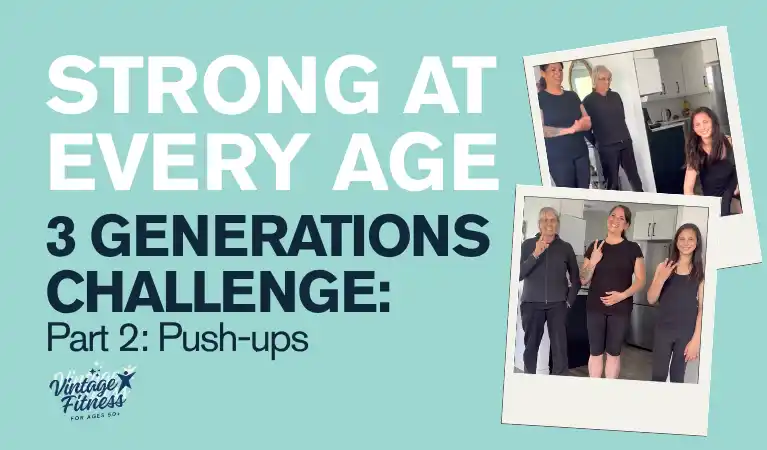
Meet Mabel, age 11, Yvette, age 48, and Grace, age 78. Three generations, one family, and a shared belief that staying strong is worth the effort at any stage of life. In Part 1 of our Strong at Every Age challenge, we asked all three to sit cross-legged on the floor, a move that trips up plenty of adults over 50. They managed it beautifully, because they have been working on their flexibility.
This week we turned up the difficulty with push-ups.
If you just winced a little, you are not alone. Push-ups have a reputation for being hard, or worse, for being something you leave behind in your younger years. One of our challengers said it out loud: "I'm too old for them." By the end of the video, she had changed her mind. That is really the whole point of this series. Strength is not reserved for the young, and push-ups are one of the most useful exercises you can keep in your routine for life.
Why Push-Ups Matter More as We Age
A push-up is a full-body movement dressed up as an arm exercise. It builds strength in your chest, shoulders, and arms, and it asks your core and back to hold everything steady at the same time. That combination is exactly what you rely on for everyday life: pushing yourself up from a chair or the floor, bracing a heavy door, lifting a grandchild, or carrying groceries in from the car.
For older adults, upper-body and core strength also play a quiet role in safety. Strong arms and a stable core give you something to catch yourself with, help you get back up with confidence, and support better posture through the day. It is never too early and never too late to start building that strength.
Three Modifications, So Everyone Has a Starting Point
The beauty of the push-up is that it scales. You do not begin on the floor. You begin where you are and work your way down over time. Here is how each generation approached it in the video.
Wall push-ups: the gentle on-ramp
Grace started standing, hands on the wall at shoulder-width, feet a comfortable step back. Keep your head up and eyes forward, shoulders relaxed and down, then bend your elbows to bring your chest toward the wall and press back out. Breathe the whole time. Want more challenge? Step your feet a little further from the wall. This is the ideal place to start for most people over 60, and it is genuinely effective, not just a warm-up.
Push-ups from your knees: the next step up
Yvette moved to the floor on her knees, hands underneath her shoulders, core tight, and hips tucked so her body stayed in one line from shoulders to knees. Lower slowly, go just a little deeper than feels comfortable, and press back up. This one is harder than it looks, especially if it has been a while, so there is no rush to get here.
Full push-ups on your toes: the goal, for some
Mabel, all 70 pounds of her, showed the classic version. Chest leads, not the face, and the movement stays slow and controlled. This is not the target for everyone, and that is completely fine. Progress, not perfection, is the measure that matters.
A simple way to bridge between these levels is to use a staircase. Start with your hands on a high stair, and as that gets easier, move down one step at a time until you are eventually on the floor. A kitchen counter or a sturdy table works the same way if stairs are not handy.
A Note for Families
If you are reading this with a parent in mind, this is an easy and low-pressure way to get them moving. The wall version takes up no space, needs no equipment, and carries very little risk for most people. You could even try the challenge together across your own generations. That shared effort is often the thing that makes a new habit stick.
Families tell us this again and again. Here is how Aatir described his mother's in-home sessions:
"It has made a world of difference for my mom's overall health, mobility and greatly reduced even her chronic muscle pain."
Every person is different, and results like these reflect one family's experience. What they show is what steady, well-guided movement can do over time.
Try the Challenge Across Your Generations
Give the push-up challenge a go this week, and bring in as many generations as you can. Then tell us how many you managed, at the wall, on your knees, or on your toes. Every rep counts.
You do not need to be in great shape to start, either. One of our clients who began completely out of breath after a short walk put it best after a few months of training:
"Now, I can do things I never thought I would be able to, hello pushups."
If you or a parent would feel more comfortable starting with guidance, working with a seniors fitness specialist is the safest way to begin. We make sure you are moving in a way that is comfortable and appropriate for your body, while still giving you something to work toward. Your first session is a comprehensive assessment, designed for seniors, so we can build a plan around your goals and any health considerations.
It is never too early and never too late to build strength. Give it a try!
Join Our Next Free Webinar
Before you go, mark your calendar. Our next free online webinar, Nervous System Regulation and Its Importance for Seniors, is coming up on November 16. It is a relaxed, interactive session where you can learn something practical, meet our team, and ask your own questions, all from the comfort of home. If you cannot make it live, every session is saved so you can watch anytime. You can explore past sessions and save the date in our webinar library.
Frequently Asked Questions
- Is it safe for seniors to do push-ups?
- For most people, yes, especially when you start with wall push-ups and progress slowly. If you have a shoulder, wrist, or heart condition, or you have had recent surgery, check with your doctor first and consider starting with a trainer who works with older adults.
- What if I cannot do a wall push-up yet?
- Then start higher and easier. Stand closer to the wall, or push against a kitchen counter so your body is more upright. The more upright you are, the less weight your arms carry. As you get stronger, step your feet back or move to a lower surface.
- What if my wrists or shoulders bother me?
- Keep your hands at shoulder-width and press through your whole palm rather than just the heel of your hand. Go slowly, stop short of pain, and keep the range of motion small at first. A seniors fitness specialist can adjust your hand position and angle so you build strength without aggravating a sore joint.
Ready to Build Strength Safely?
Vintage Fitness builds customized, progressive in-home and virtual fitness programs for older adults across Toronto and the Greater Toronto Area. Your trainer will meet you at your current level and help you get stronger, safely and at your own pace. Call us at 1-866-471-0109 or book online.
RSS Subscribe:

Search
Categories
- Abdominal / Waist Exercises
- Aches and Pains
- Aging Well
- Arm Exercises
- Arthritis
- Back exercises
- Balance for Seniors
- Core
- Diabetes
- Elastic Band Exercises
- Exercise Programs
- Fitness Goals
- Flexibility Exercises
- Guest blog
- Hands
- Heart Health
- Incontinence Exercises
- Knees
- Leg Exercises
- Mental Health
- Neck Exercises
- Nutrition
- Osteoporosis
- Other
- Personal Training
- Posture
- Sciatica
- Shoulder
- Strength Exercises
- Stretching Exercises
- Success Stories
- Virtual Training
- Webinar
- Weight Loss
- Women’s Health